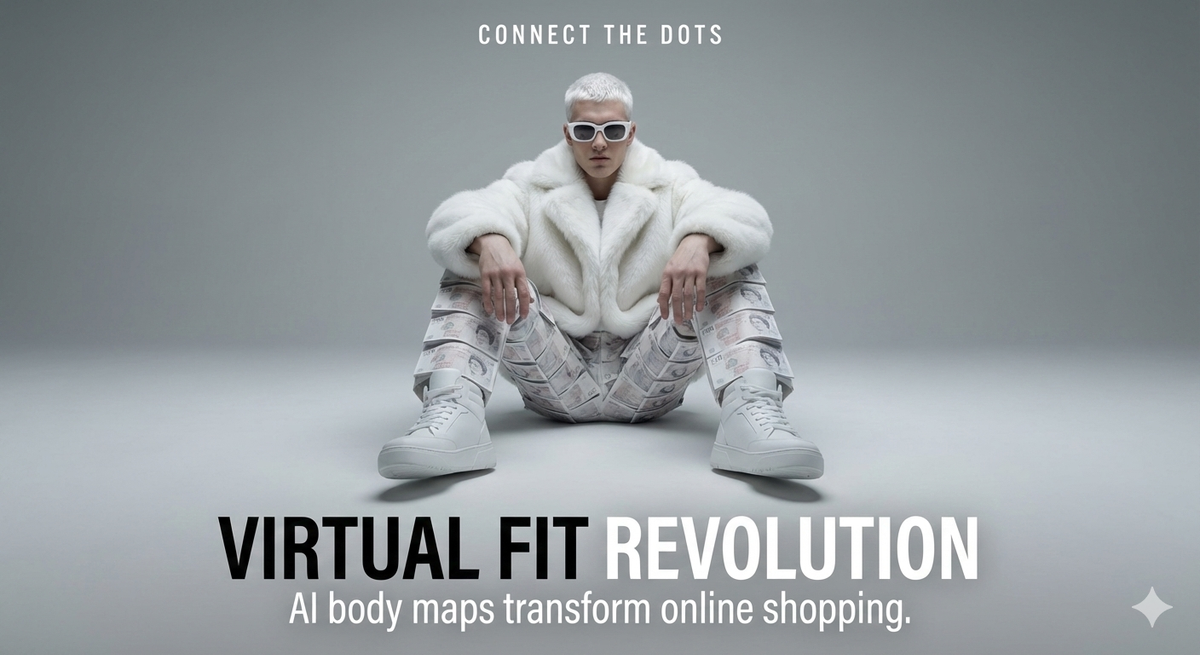
Slash returns: AI body maps perfect fit
PLUS: Healthcare AI bias exposed, $340B AI-banking shift
Morning, AI-powered body mapping could finally solve online fashion's fundamental trust problem—not by replicating fitting rooms, but by eliminating the need for returns altogether.
As virtual try-ons reduce waste and boost confidence, a bigger question emerges: Will this transparency revolution extend beyond clothing to disrupt other experience-driven markets?
Today's dots:
- AI body maps slash e-commerce returns
- Healthcare AI faces bias backlash
- Banking's $340B AI transformation
- Solo marketers profit via niche AI services
- Child AI safety tools enter testing
AI body maps slash e-commerce returns
Here's the thing: FashionKart.ai's new virtual trial rooms use real-time AI body scanning to let shoppers 'try before they buy' - cutting returns by 40% while boosting sales conversions in early tests.
Let's unpack that:
- Their patent-pending tech creates precise 3D avatars using just smartphone cameras, letting customers see how clothes actually fit their unique body shape
- Early pilots show not just fewer returns, but 22% higher conversion rates as shoppers gain confidence in purchases
- The multi-vendor marketplace aims to democratise premium tech for India's 150M+ online fashion shoppers
- Creator Anvesh Tiwari brings serious credibility - his previous fintech innovation earned recognition from Forbes India and Economic Times
If you remember nothing else: This isn't just about saving return shipping costs. It's solving online fashion's fundamental trust gap. As more retailers adopt this tech, it could permanently reshape how we shop for clothes without physical changing rooms.
AI's Hidden Healthcare Bias Problem
Here's the thing: Hospitals are deploying AI diagnostic tools without patient consent while new research reveals disturbing racial biases in devices like pulse oximeters – with experts demanding urgent transparency laws. (Source)
Let's unpack that:
- Patients are rarely told when AI influences their care decisions, eliminating their right to question or opt out of potentially biased algorithms (studies show tools can be 20% less accurate for Black patients)
- AI trained on historical medical data often bakes in discriminatory patterns – like an insurer's algorithm that prioritised healthier white patients over sicker Black ones during COVID
- Common devices like pulse oximeters and temperature scanners have proven bias against darker skin tones, leading to dangerous underdiagnosis (research exposes how these flaws persist in AI-enhanced versions)
- Current US privacy laws (HIPAA) don't require doctors to disclose AI usage, leaving patients in the dark about automated decisions affecting their care
If you remember nothing else: Your right to understand AI's role in your healthcare is non-negotiable. Asking "Is an algorithm influencing my treatment?" could be the difference between perpetuating systemic bias and receiving truly equitable care.
Banking's Invisible Future: 5 AI Shifts That Matter Now
The big picture: Banking is dematerialising faster in Gulf markets than anywhere else - what London and NYC will face in 2030, Dubai and Riyadh are solving today.
Critical developments:
- $340B AI value capture now documented through smarter compliance (30% cost reduction) and hyper-personalisation (+18% engagement)
- Real-time corridors: UAE-Saudi payment networks process transactions faster than SWIFT with native AI fraud screening
- "Invisible banking" adoption: 41% of GCC consumers have used embedded loans/vouchers without realizing they were bank products
- Asset tokenisation: Projects like EMAAR's digital twins initiative could unlock $120B in illiquid property value
- New rulebooks: KYMM ('Know Your Machine') frameworks require explainable AI decision trails by Q3 2026
The decisive edge: Gulf institutions that combine three capabilities - instant payments infrastructure, hybrid cloud AI architectures, and regulatory sandbox access - will capture 80% of the region's embedded finance growth through 2030.
Solo AI Marketers Hit $100/Day With Hyper-Specific Services
Here's the thing: Solopreneurs are launching profitable AI marketing businesses by focusing on ultra-niche services like chatbot lead generation – no tech background required.
Let's unpack that:
- Specialising in one service (like social media automation or AI email campaigns) lets solo operators compete with larger agencies by delivering faster results
- Clients care about outcomes not effort – AI tools allow you to deliver performance-based solutions without burning out
- The starter toolkit is simpler than you think: AI writing tools, basic automation platforms and analytics dashboards cover most client needs
- Early success comes from documenting your process publicly – share case studies before you even land first clients
If you remember nothing else: Niche focus combined with AI automation creates lean, high-margin marketing businesses. Forget generalist approaches – tomorrow's winners will own microscopic service categories.
Child AI Safety Tools Reach Testing Phase
Here's the thing: A new AI risk-scoring platform enters beta testing to help schools and parents audit educational tools - responding to findings that 70% of teens use AI without safeguards (AI Safety Daktari launches tools).
Let's unpack that:
- The platform audits bias risks, data privacy gaps and inappropriate content exposure in children's AI tools - translating complex safety metrics into actionable reports for adults
- Comes as studies show fewer than 20% of educators receive AI risk training, leaving most schools unequipped to evaluate tools students already use daily
- Unlike basic parental controls, the system evaluates dependency patterns and long-term learning impacts - applying industrial safety frameworks to digital environments
- Founder Dr. Richardson brings 40+ years of risk engineering experience from healthcare and biotech sectors, applying regulated industry standards to AI development
If you remember nothing else: Unchecked AI exposure during formative years could shape children's worldviews and learning habits irreversibly. These tools represent our first concrete step toward proactive rather than reactive youth protection in the algorithm age.
The Shortlist
Finance collapses as 'electro-industrial stack' reshapes enterprise software - Andreessen Horowitz warns institutions will abandon legacy vendor contracts for AI-native alternatives by 2026. Are we seeing Silicon Valley's next trillion-dollar pivot?
Education searches for AI essay tools spike 1,482% in Hawaii - study shows students increasingly use 'research assistants' over ghostwriters, with Alaska and Delaware trailing close behind. Is this how Gen Alpha learns critical thinking?
Unitree kicks its human operator squarely in the groin during motion-capture demo - viral Bilibili video sparks fresh 'misalignment' debates while showcasing G1 robot's precision. Did Isaac Asimov's first law just fail its real-world stress test?