Ready or Not: 2026 is the year of the AI Agent
When inventory, orders, pricing, and customer context live in multiple systems that don't easily talk to each other, both humans and AI struggle to deliver consistent experiences.

PLUS: The jobs most exposed to Generative AI and why personal branding matters more in an AI driven world.
“...what enables the wise sovereign to strike and conquer, and achieve things beyond the reach of ordinary men, is foreknowledge.”
― Sun Tzu, The Art of War
Afternoon All,
You can't say you weren't warned. The signs are everywhere. AI is no longer coming. It's here. Whether you're running a company or simply working for one, this will affect you. In different ways, and to different degrees, sure. But make no mistake it will affect you. The question now is how prepared are you? In either scenario, how ready are you to fully take advantage of all the opportunities AI is going to give you. More importantly, how prepared are you to deal with the risks and challenges AI is also going to give you?
We explore all that and more next...
Today's dots:
- Is your data ready for the year of the AI Agent?
- 90% of Retail Execs Expect AI to Disrupt eCommerce
- The Jobs Most Exposed to Generative AI according to Microsoft
- Why personal branding matters more in an AI driven world
Is your data ready for the year of the AI Agent?
Here's the thing: Agentic AI promises to help retailers deliver a long held goal of providing a brilliant seamless or multi-channel buying experience. To achieve this in the AI era, data becomes the most important ingredient. When inventory, orders, pricing, and customer context live in multiple systems that don't easily talk to each other, both humans and AI struggle to deliver consistent experiences.
Are retailers ready to fully utilise the power of agentic AI?
Let's unpack that:
- For many brands, inventory visibility differs by channel, fulfillment networks aren’t synced, and pricing and promotions may not be consistent across touchpoints. With those inputs, even advanced probabilistic AI can’t “act intelligently,” and give reliable outputs.
- Retailers need the ability to deliver consistent experiences across channels and geo's. Real-time truth for stock, orders, pricing, and customer context, regardless of where the transaction starts.
- For some retail departments, agentic AI will be about AI generating content. According to Tradebyte's latest report, brands leveraging AI for content creation have achieved sales increases of 5–15% and reductions in return rates between 5–20%.
- For most retail operations it will be more about AI executing tasks within business systems, such as, resolving customer service tickets, updating product feeds, forecasting, pricing decisions, or stock allocation.
- Ultimately, success in 2026 won't be defined by how many AI features a retailer deploys, but by how well their systems can interpret context, act reliably, and scale under pressure.
If you remember nothing else: AI adoption will unavoidably be full speed ahead across Europe. Unified data, effective operational governance, and resilience will be the traits that set winning retailers apart from the rest of the pack. Agentic AI only amplifies what already exists. Strong unified data creates a solid foundation on which you can build meaningful results and ROI. Fragmented systems are a tower of sand that only amplify risk and confusion.
90% of Retail Execs Expect AI to Disrupt eCommerce
Here's the thing: AI driven product discovery is quickly replacing traditional search. If the machines don't have love for your site, then you know how the story ends. For brands, visibility now depends on how well machines read intent, not how well pages rank. As AI shopping agents become more common place, brand loyalty becomes harder to foster. The connection and buying decision now shifts from recognition to relevance.
Let's unpack that:
- Deloitte’s 2026 Retail Industry Global Outlook reports nearly 90% of retail executives expect AI-driven discovery to surpass traditional search engines soon.
“Showing up now depends on how well machines understand your product. What once required multiple steps - searching, clicking, and comparing - has been compressed into a single, AI-driven interaction.” - Jeff Nordstedt, Director of User Experience at eDesign Interactive,
- Deloitte's report also found that about half of retail executives expect the traditional multi-step shopping journey to collapse by 2027. Brand loyalty, and emotional marketing become less important as brands will need to optimise for the criteria important to how agentic systems search, interpret, and recommend products.
If you remember nothing else: AI discovery demands structured data, if product data isn’t structured clearly, AI can’t recommend it. This is business critical. In the next 12 to 24 months, brand visibility will depend entirely on how well systems, and not just people, can find, understand, and recommend your products.
The jobs most exposed to Generative AI,
Here's the thing: AI will cause job losses. That is an undeniable reality. That reality will hit some industries sooner than others, but make no mistake it will hit all of us. According to a Microsoft study, the industries most exposed are industries that contain many language-heavy and information-based roles.
Let's unpack that:
- Microsoft assessed AI exposure using three indicators derived from Copilot usage: Coverage: How frequently tasks associated with a job appear in Copilot conversations, Completion: How often Copilot successfully completes those tasks and Overall AI Applicability Score: A combined measure of how suitable AI is for supporting or performing tasks in a given role
- The top 10 is as follows:
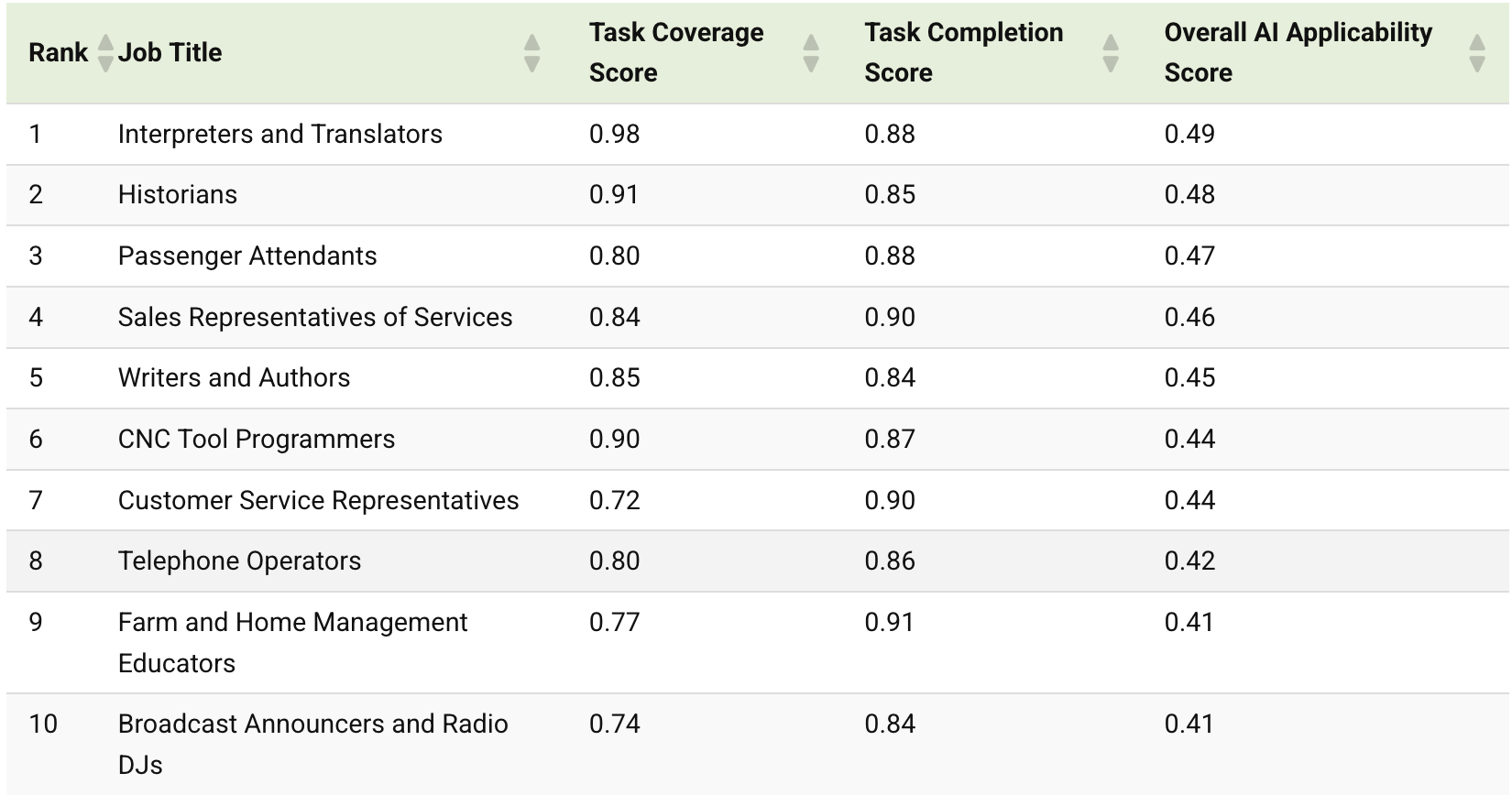
- While creative and communication-based jobs dominate the top of the list, technical roles like data scientists, web developers, management analysts, and market research analysts also show AI is already capable of successfully completing most tasks that are assigned to it in conversations.
- In practice, generative AI is more likely to increase the productivity of each worker rather than eliminate entire roles. This will mean at the very least, companies will need less workers to complete the same output.
- By contrast, roles that require physical effort and on-the-spot human judgment, including machine operators, repair workers, and caregivers, remain far less exposed to AI, since these tasks are still difficult to automate.
If you remember nothing else: Jobs with repetitive and standardised tasks may see faster transformation as AI tools become more ingrained in daily work. Many of the most exposed jobs involve judgment, creativity, or human interaction, where AI functions as a complement rather than a substitute.
Why personal branding matters more in an AI-driven world
Here's the thing: As I've written above, the jobs of knowledge workers are increasingly being exposed to AI systems. In a not too distant future when the AI layoffs inevitably come, a personal brand that conveys trust, credibility and AI expertise could be the key differentiator in keeping your job.
Let's unpack that:
- Research from Stanford University shows that stories are remembered far more effectively than raw information. Your story, made up of your experiences, failures, insights, and lessons create a narrative unique to you. If that story reads credibility, that credibility shortens sales cycles, strengthens partnerships, and reassures stakeholders when it's decision making time.
- As AI becomes embedded in daily business, human connection becomes even more important. This human layer often sustains support during difficult times, when metrics alone are not enough.
- AI has lowered the cost of content creation, increasing sameness across brands. This democratisation of production has caused AI Information overload and reduced attention spans. Trusted authentic voices become more valuable and this authenticity, is something algorithms cannot replicate.
If you remember nothing else: Your personal brand often arrives in places before you do. In the near future AI will unavoidably impact all of our employment prospects. Having a personal brand that conveys the right messages may be the difference between a career that thrives or one that gets left behind.
The Shortlist
Other stories you might find worth your time...
 Lauren Forristal
 Peter Aykens
 Maliha Shoaib
 See full bio