How The AI Knowledge Worker Will Succeed in 2026
The best question to ask right now isn't "Will AI take my job?". The best question is: Is AI going to take over the part of your job that makes you most valuable?

PLUS: Where AI is winning in real businesses
"Successful people ask better questions, and as a result, they get better answers." - Tony Robbins
Morning All,
Before Uber was a thing, black cabs (in London) were the gold standard. Their USP was they knew London roads better than anyone. Each driver had to pass "The Knowledge" exam to prove it. Anyone who has every taken a black cab knows they were paid accordingly. Sat nav and Google Maps put that same knowledge in the hands of everyone. All of a sudden their USP wasn't so unique or valuable. Uber grew, the number of drivers skyrocketed and wages for cab drivers dropped.
In between going toe to toe with the US DoD (and winning), Dario Amodei has reiterated his belief that 50% of all entry-level white collar jobs will be lost to AI within 1 - 5 years. Even if he's half right, that would be an historically seismic change.
The best question to ask right now isn't "Will AI take my job?". The best question is Does your job put you in a similar position to the black cab driver? Is AI going to take over the part of your job that makes you most valuable? If the answer is no, then hear me out. You have a huge opportunity.
We'll explore that and more in today's edition.
Today's dots:
- What an AI native law firm looks like in 2026
- The Future of Finance – The Path to Your AI Operating System
- The era of the AI powered knowledge worker
What an AI native lawyer looks like in 2026.
Here's the thing: It is now possible to run a 2 person boutique law firm, and outwork firms with hundreds or even thousands of lawyers. A small firm built around AI is now capable of producing in 2 hours, what a team of three associates at a mid-size firm would need all night to match. In Zack Shapiro's recent article "The Claude-Native Law Firm", he details exactly how he deploys AI in his day to day legal practice.
Let's unpack that:
- Picture the scene, a lawyer has a client deliverable that involves comprehensive research spanning multiple government agencies and overlapping statutory frameworks. Shapiro says the required output is "a structured research memo, with a bottom-line-up-front summary, specific statutory citations, and practical recommendations." He'll then review every citation, verify the analysis, and use judgement to make any necessary revisions. That deliverable would take a junior associate days to produce. Claude delivers a first draft in under an hour.
- This has huge implications for SME's and especially entry level and junior employees. Small firms can now handle the workload of much larger ones and still provide the level of attention that's impossible at large firms. All as a direct result of AI use. The work that would historically justify hiring a junior employee, can now be handled by your AI of choice. First-drafts, research memos, document summaries, routine correspondence, all done under the supervision of a senior employee, in a fraction of the time.
- Shapiro stresses "Associates are not obsolete. But the bar for when hiring one makes economic sense has moved. And what you need them to do has changed: judgment, client relationships, and AI output supervision, not 2,000 hours of document production"
- He goes on to say "The lawyers who will win with this technology understand at a foundational level that the AI is not practicing law. You are practicing law. The AI makes you faster, more thorough, and more consistent. But the judgment, the part where you decide what to fight for and what to concede, where you read between the lines, where you make a call that could go either way and stake your reputation on it, that is yours".
If you remember nothing else: If you’ve spent 10 or 20 years developing judgment in your career, you are sitting on exactly the asset and expertise that AI makes more valuable, not less. As long as you don't use it as a substitute for your own thinking.
The Future of Finance - An AI Operating System
Here's the thing: Imagine a future where a finance professional can simply ask a complex, cross-functional question in natural language and receive a trusted, immediate answer, without needing to know which system holds which piece of data. This is the finance endgame, laid out by KPMG. The future of the finance function is shifting from being reactive historians to proactive operators. The key to this future is a real AI Operating System. Where AI is not just a tool but a core capability.
Let's unpack that:
- A single source of truth. The holy grail for most finance and operations teams. A senior leader asks a simple question. It takes your team half a day to wrangle data from 3 different sources. You finally get an answer and the exec just replies "Thanks". Sound familiar? Lack of data unity remains the primary bottleneck to unlocking AI's true potential. The key is to use "AI for Data," automating the monumental tasks of data cleansing, integration, and governance.
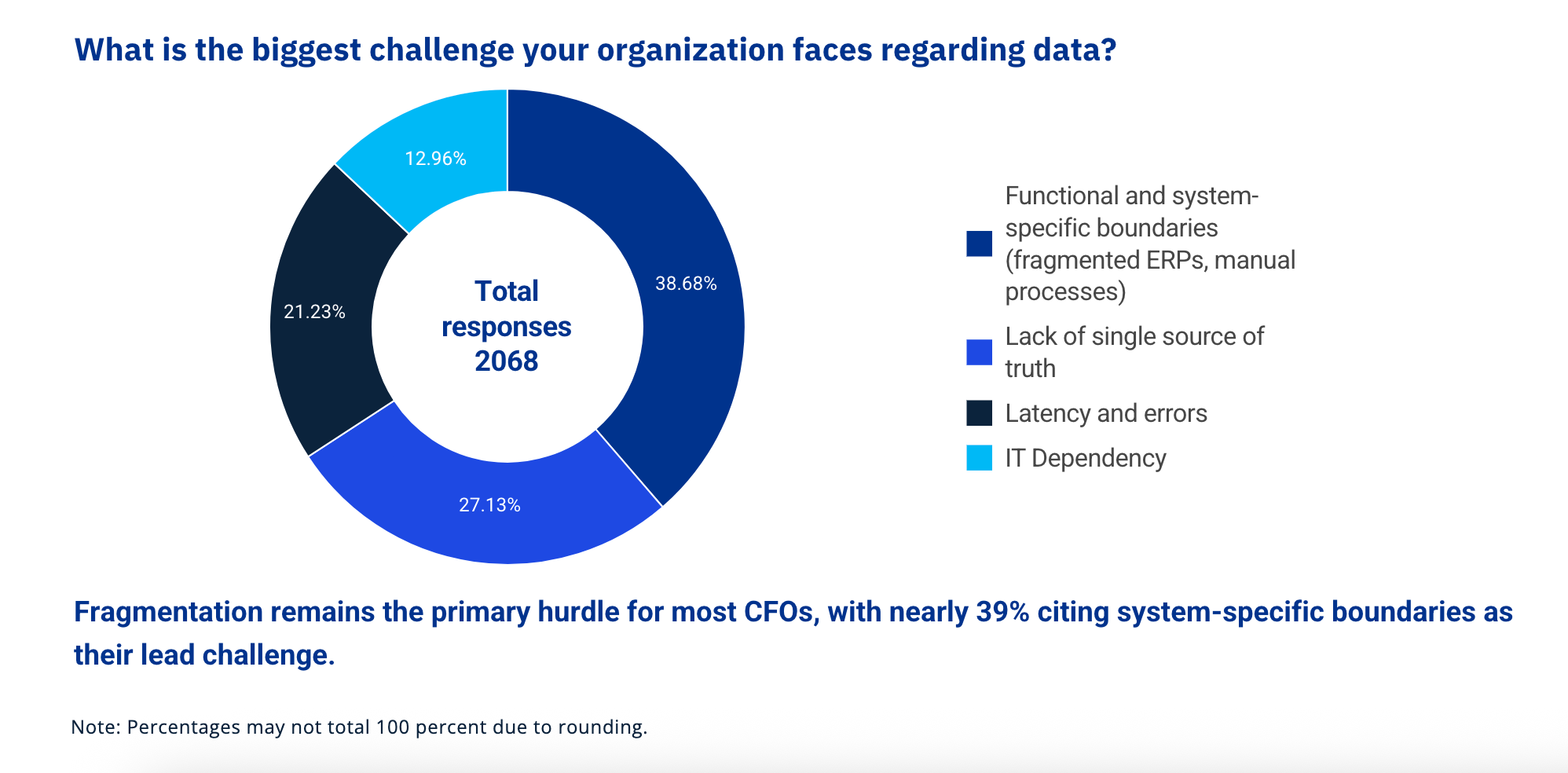
- You must have a vision for where you want to go, because in the age of AI, standing still means falling behind. The KPMG report states "As AI automates transactional work, the finance organisation is set to transform into the "conscience" of the company—ensuring governance and fiduciary oversight for AI use—and its "compass," using data-driven insights to influence and guide business strategy".
- This is how finance professionals and teams can make themselves important in the AI economy. Strategic thinking, judgement, leadership and other intangibles become invaluable. Any department that can liberate themselves from the tedious time consuming process of data retrieval to focus on high-value analysis and strategic counsel, will be worth their weight in Gold.
If you remember nothing else: The path to an AI-powered finance function is no longer a futuristic vision but a tangible reality for the present. Finance professionals who act now will create a powerful competitive advantage. Using AI to master data cleansing, integration, governance and other transactional tasks will elevate yourself and reimagine the very purpose of your finance department.
The era of the AI powered knowledge worker is here.
Here's the thing: Picture a future where instead of an office full of human employees working 9 - 5, you have an army of AI employees working 24/7/365. That future is now. Anthropic unveiled a wave of new Claude Cowork plugins that handle workflows for HR, investment banking, engineering, design, private equity, and more. They're not alone. Perplexity have just released Computer, a new general purpose digital worker that leverages 19 different AI models.
Let's unpack that:
- In addition to the new Cowork capabilities, it now lets you schedule tasks for the future. Users can now create recurring automations for repetitive tasks, which can run automatically on your chosen cadence as long as the Claude Desktop app is open.
- Computer is Perplexity’s new multi-model AI agent system. The tool breaks down complex projects into subtasks, and then directs each subtask to one of 19 different models that’s best suited for the job. Perplexity claims that Computer can run for hours or even months.
If you remember nothing else: A future where you can give an AI agent a task or project, step away from your computer or even go to bed, wake up and have it completed for you, is now a reality. The technology is ready, are you? This will be what separates the winners and losers in the new AI economy.
The Shortlist
Other stories I think are worth your time...
 Emma Bryson
 Armando Roggio
 Liam Bastick, CGMA
 Sophie Smith