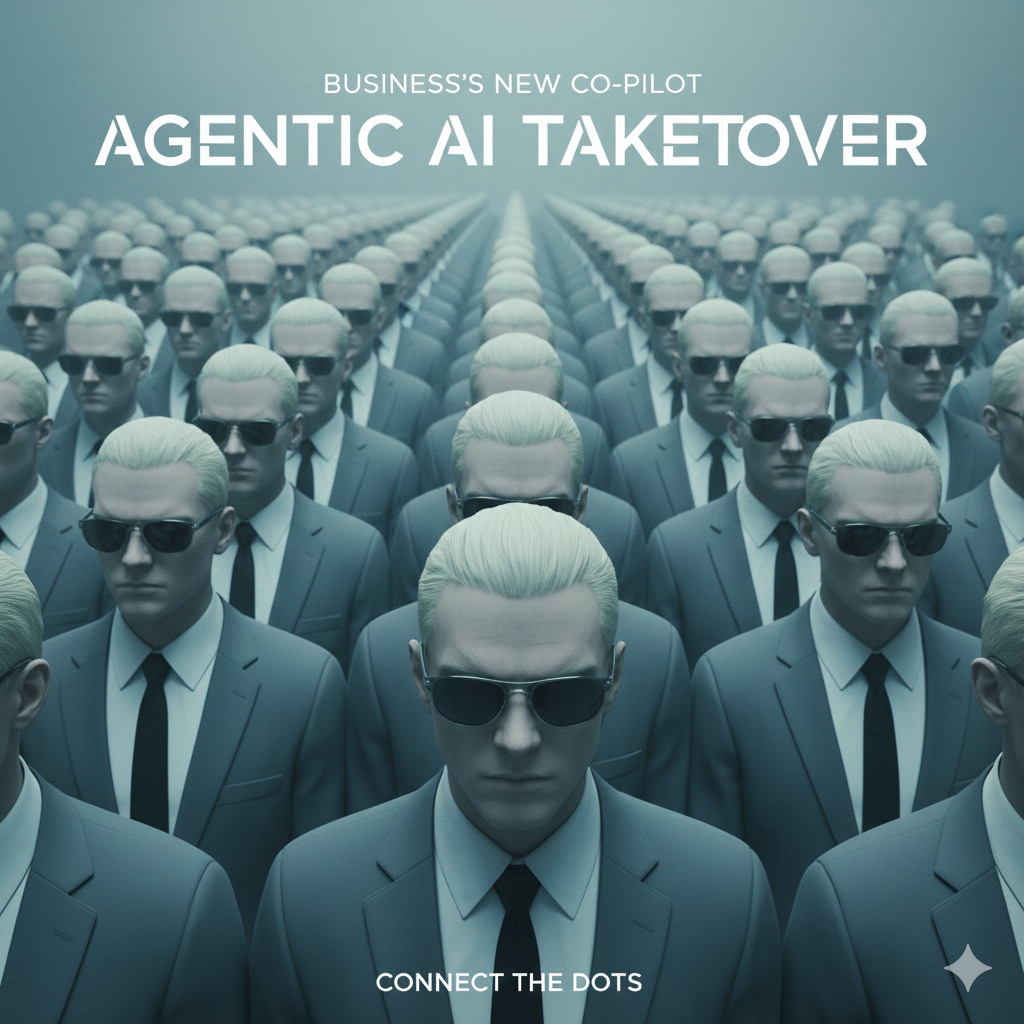
Agentic AI takes command of 80% enterprise machinery
Enterprises are shifting operational control to self-directing AI systems, with major consultancies predicting autonomous workflows will soon manage most machinery operations.
PLUS: Apple Watch’s Workout Buddy cuts dropouts, DeepSeek’s 6x training leap, robotic therapy hits 60% gains
Morning, Enterprises are shifting operational control to self-directing AI systems, with major consultancies predicting autonomous workflows will soon manage most machinery operations.
This agentic transition raises critical questions: As AI begins executing decisions without human intervention, how do we balance efficiency gains against transparency requirements in regulated sectors?
Today's dots:
- Agentic AI commands enterprise machinery
- Apple Watch curbs workout dropouts
- DeepSeek's 6x cheaper AI training
- 60% efficiency leap in robotic therapy
- OpenAI's screenless 'Gumdrop' pen
Enterprise AI Goes Autonomous: Your Business's New Co-Pilot
Here's the thing: Businesses are handing the keys to mission-critical workflows, with PwC predicting 80% of embedded finance growth will flow through agentic AI systems by 2030. Forget chatbots – these self-directed agents now handle everything from supply chains to equipment maintenance.
Let's unpack that:
- Retailers and manufacturers have moved beyond pilot programs, deploying AI for real-time inventory tracking and predictive machinery upkeep – cutting costs by up to 17% according to this MSN industry roundtable
- IBM's 2026 forecast shows agentic systems aren't just analysing data but executing decisions – authorising payments or rerouting shipments without human intervention
- Enterprises now build dedicated AI studios, with PwC noting centralised agent platforms could boost workforce productivity by 30-50% in targeted workflows
- Despite progress, McKinsey reveals data verification bottlenecks stall scaling – only 28% of firms reliably operationalise AI insights across departments
- Legal teams scramble as Stanford's 2025 AI Index tracks 34% more nations implementing strict agent transparency rules for algorithmic decision-making
If you remember nothing else: The migration from human-supervised AI to agentic workflows will redefine operational efficiency benchmarks by late 2026. Early adopters aren't just cutting costs – they're building self-optimising business models that compound advantages.
Apple's AI just cracked the fitness dropout code
Here's the thing: Apple Watch's new Workout Buddy uses behavioural psychology and real-time health data to boost workout adherence, backed by an upcoming AI health coach that could reshape the $190B wearables market starting next week.
Let's unpack that:
- The system retroactively credits missed workouts using Apple Gadget Hacks' manual logging feature, preserving motivation-driving streaks that normally break due to technical hiccups
- Real-time group sessions connect up to 32 users (via Cult of Mac's report) combating isolation - the #1 reason 67% abandon routines
- The rumoured Health+ AI coach (per ETEdge Insights) explains why you should rest after poor sleep instead of just ordering "Close your rings!"
- Wearables market projections hit $190B by 2032 as demand spikes for hyper-personalised health tech like Apple's
- 55-62 hour battery life (Economic Times test) removes charging anxiety that derailed 42% of users' tracking consistency
If you remember nothing else: Apple's blending hardware sensors with explainable AI creates accountability loops that actually stick. This isn't just smarter tech - it's behaviour change science baked into your wrist.
DeepSeek's hyper-efficient training cuts AI scaling costs by 6x
Here's the thing: China's DeepSeek just cracked a major scaling bottleneck with its Manifold-Constrained Hyper-Connections method - enabling 6x efficiency gains in AI training while drastically reducing instability, according to new research detailed in this Business Insider report.
Let's unpack that:
- The breakthrough solves the 'information overload paradox' where expanding models causes performance breakdowns - letting AI labs safely scale while maintaining coherence
- Early tests show 6x efficiency gains - crucial for cutting the $300M+ training costs of frontier models, as detailed in DeepSeek's technical paper
- Could help Chinese firms bypass NVIDIA's CUDA dominance - analysts call it a "strategic differentiator" in the global AI race
- Comes as DeepSeek prepares its next-gen R2 model - delayed by both chip shortages and quality concerns per The Information
If you remember nothing else: This isn't just about faster chips - smarter training architectures could let smaller players compete with Big Tech's compute advantage. By making scaling exponentially cheaper, DeepSeek's approach could democratise access to frontier AI systems.
AI Therapy Bots Get 60% More Efficient - Here's Why That Changes Recovery
Here's the thing: NeuRehab's new AI rehabilitation system uses spiking neural networks to deliver 60% power savings and faster response times in robotic therapy - making recovery more accessible for stroke patients worldwide.
Let's unpack that:
- Spiking neural networks process data more like biological brains, enabling ultra-efficient calculations that slash power consumption while maintaining precision
- The Hybrid-SAC system combines these ultra-efficient spiking networks for movement control with traditional AI for learning adaptation - best of both worlds
- Real-time torque sensors let the system adjust resistance moment-to-moment based on patient capability - like having a therapist who never tires
- Tested on shoulder rehabilitation exercises, it provides just enough assistance so patients build strength without causing strain
- This efficiency breakthrough matters because 80% of stroke survivors need physical therapy, but only 31% receive adequate treatment today
If you remember nothing else: More efficient therapy robots mean affordable, at-home recovery options could soon become reality. For the 1 billion people needing physical rehabilitation worldwide, this 60% efficiency leap makes continual progress-tracking treatment genuinely scalable.
OpenAI's Screenless Pen Puts ChatGPT in Your Pocket
Here's the thing: OpenAI’s new ‘Gumdrop’ pen with Jony Ive turns handwritten notes into ChatGPT conversations and delivers voice responses in under half a second – no screens required. Announced alongside a Q1 voice model update enabling sub-500ms responses.
Let's unpack that:
- The pocket-sized device acts as your third core device – designed to sit alongside phones and laptops for frictionless note-taking and AI brainstorming during meetings or fieldwork
- ChatGPT’s new audio architecture (detailed here) enables real-time interruptions and natural conversational flow, removing the ‘robot pause’ we’ve all endured
- Foxconn manufacturing in Vietnam (not China) signals geopolitical awareness – crucial for enterprise adoption in regulated industries
- Unlike Humane’s failed AI Pin, this focuses on a single high-value use case: converting your analog workflow moments into digital AI sessions without app overload
If you remember nothing else: This isn’t just a fancy recorder. It effectively shifts AI interaction from reactive queries to proactive co-creation during your most valuable thinking time. The true innovation lies in what disappears – screens, typing delays, and those awkward ‘wait, let me pull up my phone’ moments.
The Shortlist
DeepSeek unveils Manifold-Constrained Hyper-Connections training architecture that safely expands AI models with 6x efficiency gains. Could this be the breakthrough that democratises large-scale model development?
Biotech warns of generative AI's ability to create synthetic DNA/proteins as 4 nations enact screening laws while Microsoft research shows biosecurity software misses 68% of AI-generated toxin sequences.
Grok faces backlash after xAI's chatbot publicly generated sexualised images of minors - a National Center for Missing Children report notes zero prior CSAM disclosures from the firm despite workers encountering abusive content.